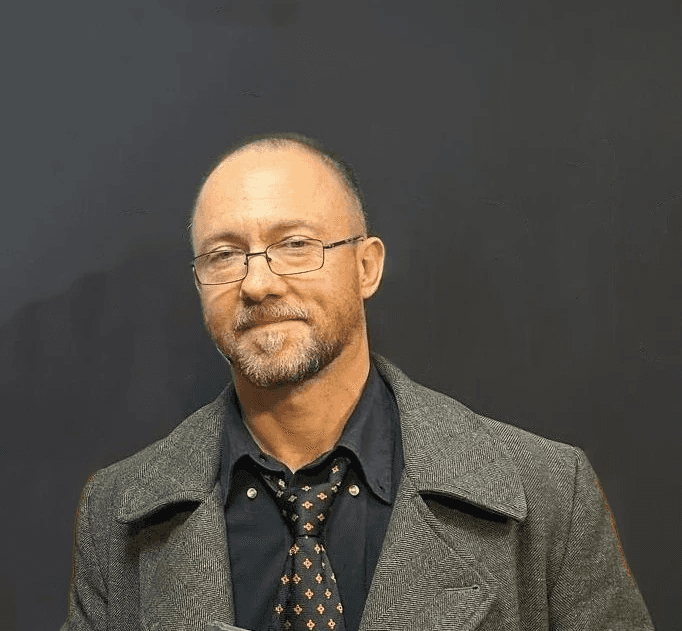
Cătălin
Pavel
archaeologist
ABOUT THE RESIDENT
Cătălin Pavel (born 1976) is a Romanian writer and archaeologist, currently an Associate Professor of Archaeology at the Ovidius University in Constanța, Romania, where he coordinates PhD dissertations and directs the University’s excavations in a sector of the ancient city of Histria by the Black Sea. He published some twenty books in Romania, of which only a few are available in other languages. An example is his novel, “La septième partie du monde”, Editions Non Lieu, Paris, 2017 (tr. by Florica Courriol). His “L’archéologie de l’amour”, Éditions de l'Aube, La Tour d'Aigues (2022, tr. by Florica and Jean-Louis Courriol; also Italian translation by Bruno Mazzoni, Neo Edizioni 2022) consists of archaeological case studies ranging from the Paleolithic to the Pompeian brothels, from Columbus’s first city to First World War cemeteries, and aims to discuss the extent to which we can reconstruct feelings from material culture.
In his “Les animaux et nous. Une enquête archéologique”, Flammarion, 2026 (tr. by Florica and Jean-Louis Courriol, also Turkish translation by Metin Omer, Gordium, Ankara, 2025). Pavel investigated the way humans interacted with animals – chapters on dogs, cats, horses, but also whales, hedgehogs, birds, and bears - throughout prehistory and Classical Antiquity. His PhD dissertation was published as ”Describing and interpreting the past - European and American approaches to the written record of the excavation”, University of Bucharest Press, Bucharest 2010. Pavel participated in archaeological excavations in Germany, France, Morocco, Israel, the UK and particularly Turkey (Troy, Miletus and Gordion), and enjoys communicating science.
ABOUT THE RESIDENCY
Topophilia and memory: the ruin as foundation
Terra Dacica, perhaps the most direct of all the territories, addresses the central theme of the entire project: the relationship between artefact and foundation. At first glance, a ruin or an artefact seems to be the exact opposite of a foundation. The residency here starts from the premise that the “forgotten” remnants along the trail, from Dacian fortresses to the dwarf dinosaurs of Hațeg, represent the moral foundation of contemporary communities. Many hikers who travel the route say that they have learned more history by walking through these places than they ever did during their school years. In this context, the trail becomes an experience of moving through a space, where the historical layers of the territory literally become levels of knowledge that the hiker accumulates by traversing them physically, kilometre after kilometre.
The aim of the residency is to rediscover, in the sense of highlighting the importance of, a specific remnant (an archaeological site, a ruin, or a place with a significant historical charge) and to present the story of that place in an accessible way. The resident must find that fragile balance in which an archaeological site ceases to be merely an “object of study” and becomes, for the hiker passing through it, a story that they can carry with them and pass on.
ABOUT THE REGION
At this point in the journey, immersed in thoughts of all kinds, the hiker arrives in Terra Dacica. They stop at the sanctuary of Sarmizegetusa Regia, and in the Hațeg region they are greeted by the image of dwarf dinosaurs. They find themselves at a moment when their understanding is put to the test. If these communities bring the hiker closer to their history and cultural heritage on a human level, here they must find a way to perceive the ruin as something more than just a pile of stones.
Terra Dacica is the region of the Via Transilvanica trail that crosses the counties of Alba and Hunedoara, two territories layered with successive strata of the country’s ancient and recent history. Dacian fortresses, Roman ruins, medieval fortifications, and historic towns transform the journey into a passage through different eras that continue to intertwine within the landscape of the present. Here, the archaeological excavation deepens, reaching into the layers of the distant past.
ABOUT THE CULTURAL IMPRINT LEFT ON THE REGION
The outcome of the residency will be a bilingual (Romanian-English) informational panel containing the history of the chosen artefact, site, or ruin, along with a QR code that allows anyone to listen to the story directly on site. The panel becomes a permanent point along the trail, accessible to all hikers who pass through, regardless of whether they have any prior knowledge of history or archaeology.


